Monday, July 21, 2008
Choice - it matters.
Tuesday, July 15th
You know what I really like, as a woman? The right to choose.
In America, we associate that solely with abortion politics, but I think we’ve forgotten – yes, particularly us women – that the right to choose encompasses so much more. And we often seem to take it for granted.
I like that I get to choose my husband. I like that I get to choose how many children I will have. I like that I get to choose to have a career. Hell, I’m glad that I get to have one, at all. Same thing for going to college, even secondary school (high school). More than my right to choose where I’m going to go to college, I like that I get to go. I like that I get to choose to wear pants instead of only skirts, what day to go to the market, to speak in public if so compelled and yes, I also like that I get to choose to not have my genitalia mutilated.
Of course, being subjected to female circumcision, arranged marriages and not being able to attend high school are severe examples – but this is the reality for so many women in the world today. These are specific examples of things that many Maasai women cannot do, from my observations and interactions with the culture here in Tanzania. On Monday, we took a tour with an organization called Terrawatu, which promotes and preserves the rights and lives of indigenous people, in this case the Maasai, and which does some very positive community building. Terrawatu has three programs – a secondary school, which they provide funding and support, a traditional Maasai medicine clinic in Arusha, and lastly, they sponsor a Maasai women’s group by teaching them how to plant the traditional medicine trees and plants, harvest them, and sell them in the market to increase their economic capacity.
Our day began as we gathered at the Terrawatu office. While the founder is an American woman, she is currently back in the States – the National Director, however, is a Maasai man named Sululu. From our first moments in the office, Sululu just didn’t sit well with me – there was just something about him that I didn’t like. There was a moment where his cell phone rang in the middle of his introduction to our group, to which he responded by pulling it out, staring at it, then shoving it onto one of the women program coordinator’s who was sitting by him, ordering something at her in Swahili, then returning to speak to our group. It sounds like a minor detail, but my eyes narrowed. There was something in that small moment of how he treated that woman that spoke volumes to me, but I didn’t know the half of it – yet.
So first of all, we’re taken to the school and get to have a Q & A with some of the staff and faculty. During which time, Sululu felt it completely acceptable to interrupt some of the female teachers while they were talking – as if it was nothing. Then, he took us to the Maasai medicine clinic and told us about the traditional remedies. Afterwards, we headed out to the village to meet with the women’s group, learn about their tree-planting program and have lunch. Our lunch consisted of the traditional Maasai preparation of roasted goat. They killed two goats and roasted them on sticks for us – however, in Maasai tradition, only the men get to carve up the goat and they get to eat it first – the women and children only get the leftovers. They did let us western women eat the goat with them, but later on we saw the Maasai children eating up the bits of our leftovers in the trash area – and that was just something hard to see.
After lunch and then the explanation of tree-planting program, we divided up into two groups – men and women. The men of our group went with Sululu and the other Maasai men behind a boma and the women of our group gathered with the Maasai women in our own circle. We were told it would be a chance for us to ask questions and exchange in conversation. However, the Maasai women seemed rather reluctant to gather with us – some of them even brought over their bead-work. Perhaps it was because they have done this so many times before, or perhaps because in their culture, the women aren’t really supposed to make the big speeches or presentations – or maybe both. Angel, one of the women program coordinators, translated for us. We asked questions that we really wanted to know the answers to – such as “Do you think it’s fair that your husband gets to have multiple wives and that you have to share your husband?” To which they answered “No, it’s not fair – but it’s just the way that it is and there’s nothing we can do about it.” We asked what kind of lives did they want for their children, different or the same? To which they responded that they wanted different lives – they wanted their children to have better educations, more opportunities, and “the ability to run their own lives.” We asked if the wives all got along, or what were their interactions like. To which they responded that when their husband is not around, they all get along and share everything – but as soon as he gets home, it’s back into their separate bomas, and it becomes almost like a competition for his attention and affection. Lastly, we asked them if they had ever tried to change the way things are, and they just said “no we haven’t tried – because we know we can’t.”
Needless to say, I was rather depressed after the conversation, as well as many of the other women in my group. It’s hard to hear these women say these things about their lives – to feel like they just can’t do anything about it – to feel like they have no choice.
Adding to the disheartening reality of our exchange, we quizzed down the guys to hear about what they talked about. Most of them just did not want to talk about it – it was almost kind of strange. Finally, through a combination of on the bus ride home and when we discussed it in class the next day, we finally got it out of them – Sululu had dominated their conversation and had some extremely ridiculous, and offensive, things to say. Turns out, Sululu is quite the sexist, and, dare I say it? Misogynist. In summary, their conversation (or should I say, Sululu’s speech) was “how to dominate women and why.” It included the dangers of women being “too educated” and his own personal theory of homosexual men being a result of women having too much power in western culture. Sululu proudly told the men his story of being married to two western women – a Dutch and Italian woman – at the same time. And when in Italy at a restaurant, his Italian wife apparently got red wine in his eye, after which he hit her in the middle of the restaurant. He was arrested, and when he went before the judge his excuse was “I’m a Maasai, it’s what we do in my culture, I’m allowed to do that there.” To which the judge said, “yeah, but you’re in Italy. And now, you’re deported.” Thankfully (for their sakes) his wives divorced him – and now he’s back in Tanzania, running a non-profit, which sponsors a women’s group.
Yeah.
I just can’t even tell you how upset I was after my trip to the village and after hearing about what this man was so proudly telling all the men of the group. I know that these attitudes toward women still exist, but for the love of god, why, WHY is this man running this non-profit? I feel like it utterly and completely undermines the objectives and mission – I feel compelled to write a letter to the founder to let her know exactly what we experienced – because something tells me, she doesn’t quite know what’s going on back here in Tanzania.
Besides the unfortunate run-in with the misogynist (whose daughter is in law school, by the way – I guess educating women is okay when 1. you get to brag about her and 2. when you’re not paying the tuition bill), the day was still pretty disheartening. These women… stuck in these lives… I just can’t imagine. I appreciate so much the little things – like getting to wear pants – and I never want to take these things for granted, ever again. If people want to preserve their culture and their way of life, fine. I don’t want to stand in the way of that. But… women deserve to have a CHOICE to live their lives the way they wish – and if that results in something other than the cultural norms, well… maybe that says something about the culture. Not to be insensitive, not to be offensive, but… women deserve to choose. That’s all. But, that’s everything.

Tuesday, July 15, 2008
Chasing Waterfalls
Monday, July 14th
Friday was a nice day off and I took the time to do some errands and rest up, but Saturday and Sunday were all adventure.
On Saturday, we had a recreational activity sponsored by the program to visit Lake Diluti and then the Mt. Meru Game Lodge. We took an hour-long nature walk around the lake, during which we saw a giant lizard (I can't remember what it's called - but it looked like a Komodo Dragon - obviously MUCH smaller though). We also learned that it was a crater lake, which then became obvious as we looked around and noticed that the lake itself was in a gorge. We had lunch by the water and some of the group took out an old row boat for a tour on the water. After that, we went to the game lodge. Basically, the lodge puts out a ton of food in a nature reserve, which the lodge looks over. Then you sit there, have some coffee or tea, and watch all the animals as they graze. We saw lots of zebra, water bucks, ostriches, peacocks, monkeys and some other kind of storks. It was so nice to just be sitting there and taking it all in - it's funny though how you just become used to it so fast. When we first got there, we were snapping pictures like mad, but then after an hour or so, the animals are just... there. However, it doesn't make me any less excited for our Safari in the Ngorongoro Crater this Friday and Saturday!!!
On Sunday, 11 of the 19 group members signed up for a Waterfall hike. While I had certainly struggled on the hike when we went camping last weekend, this waterfall hike seemed too promising of an opportunity to pass it up. So we left around 9am, taking a dalla-dalla to the base of Mt. Meru. Then we hiked up a huge hill and into the village. We went to the guide's mother's home and had coffee and tea. One of the guys in our group noticed the goat and cow outside and asked if they were beneficiaries of Heifer International, to which we tried to stop his question thinking it was rude. But it turns out that he was spot on as, yes - they were. They had received their calf more recently, but that was where it came from. Asking more details, our guide only spoke positively of the organization, which just goes to prove even more the good work that they do.
After our tea break, we set out to go to the waterfall. We hiked to the top of the gorge, where we had to sit and wait for a bit. The Tanzanian army uses the waterfall and river area as their water source, therefore our guide had to go and give them a permission slip. He had to hike all the way down the gorge and up the other hill, and then it turned out that we had to sign to slip, so he had to come all the way back to us and then do it again. The man has endurance.
Once we had the full permission, we made our descent into the gorge. Let me tell you - it had rained the night before, making it the steepest, muddiest path. There was lots of slipping and falling, and of course lots of laughing - even trying to catch each other on video as we fell. As we finally got to the river, it was all so worth it. It was beautiful! But it certainly wasn't over yet. We then had to climb upstream, both along and through the river to reach the waterfall. Of course, my foot got stuck in quicksand, and of course, I made quite the scene. Refusing to abandon my 18,000 shilling (about $15) teva-rip off sandals I had bought in the market the day before, I dug my foot out - but broke my cheap shoe in the process. Well, that's what you get.

Hiking through the water itself was my favorite part - there were little waterfalls, ranging from around 3 feet tall to at least twenty feet - all along the way. But nothing could have compared to our final destination - after almost 4 hours of hiking, we reached THE waterfall. It. was. huge. It's so difficult to estimate - you'll just have to look at the pictures. But venturing a guess, I'd say enormous, several stories high at least. Despite the water being freezing cold, of course the guys jumped in (but couldn't stay in it long). Others climbed up the rocks to stand right under the falls. It was just one of those things you'll never forget - mother nature at its finest.


After taking it all in, we continued back downstream, and then back out of the gorge (which nearly killed me, but I survived!) We headed back to the house for a very late lunch around 3:30pm, but of the most delicious homemade food - vegetable curry, ugali, rice, spinach, and fresh cut cucumbers and bananas. We then made our way down the hill and were back by 5:00pm or so. It was by far the most fun day yet - exhausting, but incredible.
This week, we'll be visiting another field site with an organization called Terrawatu, and then we'll start working on our final projects. We have to choose one of the organizations we have visited and create a capacity building project for them. We'll spend most of the rest of our time here conducting research, putting the project together and then presenting it. I can't believe how fast time is going! Tanzania has grown on me in ways that I can't even explain - it doesn't even feel "foreign" here at all anymore... it just feels like... the way it's supposed to be. I'm sure those who have also studied abroad know that feeling as well. It'll be hard to leave when it's time to go, and I've only been here 3 weeks so far!
Hope you all are doing well, whatever your own summer adventures are :)
Friday was a nice day off and I took the time to do some errands and rest up, but Saturday and Sunday were all adventure.
On Saturday, we had a recreational activity sponsored by the program to visit Lake Diluti and then the Mt. Meru Game Lodge. We took an hour-long nature walk around the lake, during which we saw a giant lizard (I can't remember what it's called - but it looked like a Komodo Dragon - obviously MUCH smaller though). We also learned that it was a crater lake, which then became obvious as we looked around and noticed that the lake itself was in a gorge. We had lunch by the water and some of the group took out an old row boat for a tour on the water. After that, we went to the game lodge. Basically, the lodge puts out a ton of food in a nature reserve, which the lodge looks over. Then you sit there, have some coffee or tea, and watch all the animals as they graze. We saw lots of zebra, water bucks, ostriches, peacocks, monkeys and some other kind of storks. It was so nice to just be sitting there and taking it all in - it's funny though how you just become used to it so fast. When we first got there, we were snapping pictures like mad, but then after an hour or so, the animals are just... there. However, it doesn't make me any less excited for our Safari in the Ngorongoro Crater this Friday and Saturday!!!
On Sunday, 11 of the 19 group members signed up for a Waterfall hike. While I had certainly struggled on the hike when we went camping last weekend, this waterfall hike seemed too promising of an opportunity to pass it up. So we left around 9am, taking a dalla-dalla to the base of Mt. Meru. Then we hiked up a huge hill and into the village. We went to the guide's mother's home and had coffee and tea. One of the guys in our group noticed the goat and cow outside and asked if they were beneficiaries of Heifer International, to which we tried to stop his question thinking it was rude. But it turns out that he was spot on as, yes - they were. They had received their calf more recently, but that was where it came from. Asking more details, our guide only spoke positively of the organization, which just goes to prove even more the good work that they do.
After our tea break, we set out to go to the waterfall. We hiked to the top of the gorge, where we had to sit and wait for a bit. The Tanzanian army uses the waterfall and river area as their water source, therefore our guide had to go and give them a permission slip. He had to hike all the way down the gorge and up the other hill, and then it turned out that we had to sign to slip, so he had to come all the way back to us and then do it again. The man has endurance.
Once we had the full permission, we made our descent into the gorge. Let me tell you - it had rained the night before, making it the steepest, muddiest path. There was lots of slipping and falling, and of course lots of laughing - even trying to catch each other on video as we fell. As we finally got to the river, it was all so worth it. It was beautiful! But it certainly wasn't over yet. We then had to climb upstream, both along and through the river to reach the waterfall. Of course, my foot got stuck in quicksand, and of course, I made quite the scene. Refusing to abandon my 18,000 shilling (about $15) teva-rip off sandals I had bought in the market the day before, I dug my foot out - but broke my cheap shoe in the process. Well, that's what you get.

Hiking through the water itself was my favorite part - there were little waterfalls, ranging from around 3 feet tall to at least twenty feet - all along the way. But nothing could have compared to our final destination - after almost 4 hours of hiking, we reached THE waterfall. It. was. huge. It's so difficult to estimate - you'll just have to look at the pictures. But venturing a guess, I'd say enormous, several stories high at least. Despite the water being freezing cold, of course the guys jumped in (but couldn't stay in it long). Others climbed up the rocks to stand right under the falls. It was just one of those things you'll never forget - mother nature at its finest.


After taking it all in, we continued back downstream, and then back out of the gorge (which nearly killed me, but I survived!) We headed back to the house for a very late lunch around 3:30pm, but of the most delicious homemade food - vegetable curry, ugali, rice, spinach, and fresh cut cucumbers and bananas. We then made our way down the hill and were back by 5:00pm or so. It was by far the most fun day yet - exhausting, but incredible.
This week, we'll be visiting another field site with an organization called Terrawatu, and then we'll start working on our final projects. We have to choose one of the organizations we have visited and create a capacity building project for them. We'll spend most of the rest of our time here conducting research, putting the project together and then presenting it. I can't believe how fast time is going! Tanzania has grown on me in ways that I can't even explain - it doesn't even feel "foreign" here at all anymore... it just feels like... the way it's supposed to be. I'm sure those who have also studied abroad know that feeling as well. It'll be hard to leave when it's time to go, and I've only been here 3 weeks so far!
Hope you all are doing well, whatever your own summer adventures are :)
Heifers and Human Rights
Our Monday kicked off with a visit from US Ambassador Mark Green. He spoke to our class about his experiences (he was a school teacher in a Kenyan village twenty years ago and then was eventually a
We also had several other speakers this week, with a couple of people from the East African Community (EAC), the supranational regional organization (it’s similar to the European Union, but for
`
Starting on Wednesday, we got to get out of the classroom and go out into the field! We have two days of back-to-back field trips to visit farms which had been helped by Heifer International. A lot of you are probably familiar with Heifer (the Chapman Honors program holds a bake sale to raise funds for them on campus each year), but those of you who aren’t, Heifer International is an NGO which is dedicated to sustainable capacity building in underprivileged communities around the world – a.k.a. they don’t give aid in the form of money, but in the form of livestock, including cows, goats, chickens, pigs, beehives. It’s to kind of jump start those that need some help by giving them something that can reproduce and that they can use for so many purposes. And they don’t just give anyone a cow, but there’s an application process, and afterwards they provide training and support to the farmer to sustain the growth and prosperity. And – to make the good spread as far as possible - they are obligated by contract to give away the first female calf to their neighbor, to spread the “sharing and caring.”
So, Heifer
It just goes to show you that sometimes, people just need a little boost and that they can really do great things with just a little help. Obviously, not every story is this much of a success story, something that our group was very keen about discussing. So while not every single Heifer recipient may create a “super-farm” of sorts, it’s clear that these people who receive the cows and goats are benefitting from having at the very least more milk, meat and muscle (3 of the 8 beneficial M’s that our Heifer guide quizzed us on) that greatly improves the quality of life. It puts the responsibility in the hands of the community and empowers them to develop independently – just from receiving the initial gift. That’s what I liked the most about Heifer International, as one of the other students in my group pointed out – their philosophy is rooted in optimism and faith in fellow man, that they are not only competent, but very giving. It is nice to see an organization be successful in responsibly subscribing to that way of thought. I think we all could benefit from a little more of that in our lives.
Wednesday, July 9, 2008
Lions and Scorpions and Giraffes?- oh my, what have I gotten myself into...
Monday, July 7th
Well, we had quite the weekend! We went camping about an hour and a half away, out in the savanna by a few Maasai bomas. By the time we got to our campsite, it was completely dark outside – so it was pretty scary to be dropped off in the middle of nowhere in a strange place and have no idea what was around you. However, we had a really great group of guides who had already set up all of our tents and had built a campfire. While they were cooking our dinner over the fire, they took us to the boma right next to our site to view a Maasai wedding celebration. As we went over there, one of the guys in our group had to translate from Swahili for us – he introduced us to a 33 year-old man as the groom, and then warned us that the bride was very young – 16 years old. Well, as surprising as that was, we were way more shocked when we actually met the bride. There was no way this girl was 16 – she looked much, much younger. We were all very polite, obviously, as we watched them dance and do their traditional songs and chants, but it was fairly disturbing from my western viewpoint to see such a young girl being married off to this older man. As we went back to the camp, I kept contending that there was no way that girl was 16, which one of our guides overheard. He explained that they referred to her as being 16 for some reason having to do with the education system (which I can’t quite remember) but that she was more likely 14 years old, perhaps even 13. Whoa. I know that they marry very young in some cultures, but 14? And a very undeveloped 14, mind you.
It’s hard to comprehend such a thing. It’s a difficult situation because you want to be respectful and sensitive to other cultures and their traditions, but it’s hard when something like that just seems so wrong. It’s something we’ve talked about a lot in our coursework – how these documents, such as the UN Declaration on Human Rights, make grand statements about protecting people, but it’s a whole other ballgame when it comes to actually implementing it. The Tanzanian government has a lot of laws in place to protect women and children, including minimum ages to marry and laws against female circumcision (or what is better known as female genital mutilation, something that the Maasai participate in as well), but the laws are not consistently implemented (what seems to be a trend here in Tanzania).
Anyways, we had a great time celebrating the 4th, including roasting s’mores (made with some substitutions – nutella instead of Hershey bars, for example) and each taking turns singing our national anthems, with
The next day we went on a hike up a huge hill, well, more like a miniature mountain, and as we were walking through the woods, one of the girls in our group spotted a wild giraffe! I can’t even tell you how amazing that was to see… I think giraffes may be the most beautiful animals I have ever seen. It was just eating leaves, out there in the savanna. It was incredible. Other highlights from the weekend included when one of the guys in our group bought one of their goats for dinner. The Maasai men slaughtered it and helped us cook it. While it was a great cultural experience, I’m not gonna lie – I had no participation. I couldn’t even stomach to go over there and watch the process, or try the goat meat. It’s just too much for me.
Probably one of my most favorite parts of the camping trip was being out in the savanna at night and being able to see the stars. It’s so strange to look up and not recognize half of the night sky. Since we’re so close to the equator (like 2 hours away by car) we literally are seeing half of each hemisphere. How mind-blowing is that? As the sun set and the stars began to glitter, I could see the Big Dipper laying very low on the northern horizon and then what I think was the Southern Cross laying low on the southern horizon. I wish I had studied up on some southern hemisphere constellations before I left – it’s crazy to think I’m looking at a part of the universe I have literally never even seen before. And since the savanna is so wide open, you could literally see the entire sky and we all commented how for the first time, you could see the sky as a huge dome, feeling the roundness of the whole earth. It is something I will certainly never forget.
We’ve got a lot of things this week, including a visit from the

The savanna at sunset. Our tents were behind me and you can see the outline of the Maasai boma in the middle of the picture.

The wild giraffe!!!
Friday, July 4, 2008
Happy Birthday Merikani!
Alright, enough of my ideological rants... two in a row is probably too much. I can get carried away sometimes :) So here are some less politically-fueled updates.
This week, we finished up our speakers from the ICTR. We spoke with representatives from each of the three organs of the tribunal - the Office of the Prosecutor (OTP), the Chambers (the Judges) and the Registry (which handles all of the logistical concerns, like the detainment facility, legal aid office, etc.) The best speaker of the week and easily the overall group favorite was one of the Senior Trial attorneys from the OTP, an amazing woman who was not only incredibly sharp and knowledgeable, but a really enjoyable speaker.
We also had a lot of fun last night - one of the guys in our group, Dan, who is from Uganda, turned 22 yesterday. So we wanted him to experience his birthday in classic American style. There's this super-mart called Shop Rite which is like a mixture of a grocery store and a Target, a.k.a. a western tourist haven. Thanks to Shop Rite, we were able to buy some cheesy children's birthday hats (of course, decorated with race car pictures) and a Happy Birthday sign. The restaurant which the program has arranged for us to eat at every night puts all 19 of us in our own dining room - so we hung up the sign, donned the hats, and had a nice little birthday party - we even ordered a cake, turned off the lights and made him make a wish before he blew out the candles. After dinner, we made our way to Via Via, a cafe that turns into a club at night. Yep, classic American-style birthday celebration. We have 3 more birthdays over the next 3 weeks, so I guess we're just going to have to celebrate a LOT.
Speaking of birthdays... Happy birthday America!!! We have this Friday afternoon free and all of Saturday and Sunday, so a group member arranged a 2 night camp out in a Maasai Village. We're going to rent tents, set up a bonfire, and roast s'mores out in the savanna, celebrating America's Independence Day the very best we can. It's a "Maasai 4th of July", if you will... okay, bad joke :)
I've been able to post a lot lately because we've been going to the Center everyday this week, and I'm able to hook up my laptop to an ethernet connection during our breaks. I'm still having a hard time loading pictures, so I'm really behind, so here's some more pics to catch you up.

Brian, our friend from Miracle Corners, with Kim, Dave and Mary, at the Nijiro Shopping Center, the most modern and western friendly place in all of Arusha - a.k.a. we kind of try to avoid it now :)
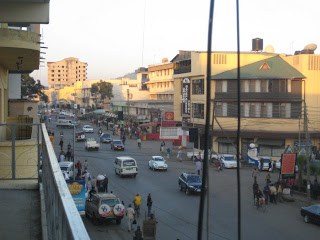
The view of downtown Arusha from the balcony outside of our room... it actually looks quite nice at dusk.

We couldn't resist this photo-op... Brian is a natural poser, clearly.

Dan blowing out the candles at his American Birthday Celebration
This week, we finished up our speakers from the ICTR. We spoke with representatives from each of the three organs of the tribunal - the Office of the Prosecutor (OTP), the Chambers (the Judges) and the Registry (which handles all of the logistical concerns, like the detainment facility, legal aid office, etc.) The best speaker of the week and easily the overall group favorite was one of the Senior Trial attorneys from the OTP, an amazing woman who was not only incredibly sharp and knowledgeable, but a really enjoyable speaker.
We also had a lot of fun last night - one of the guys in our group, Dan, who is from Uganda, turned 22 yesterday. So we wanted him to experience his birthday in classic American style. There's this super-mart called Shop Rite which is like a mixture of a grocery store and a Target, a.k.a. a western tourist haven. Thanks to Shop Rite, we were able to buy some cheesy children's birthday hats (of course, decorated with race car pictures) and a Happy Birthday sign. The restaurant which the program has arranged for us to eat at every night puts all 19 of us in our own dining room - so we hung up the sign, donned the hats, and had a nice little birthday party - we even ordered a cake, turned off the lights and made him make a wish before he blew out the candles. After dinner, we made our way to Via Via, a cafe that turns into a club at night. Yep, classic American-style birthday celebration. We have 3 more birthdays over the next 3 weeks, so I guess we're just going to have to celebrate a LOT.
Speaking of birthdays... Happy birthday America!!! We have this Friday afternoon free and all of Saturday and Sunday, so a group member arranged a 2 night camp out in a Maasai Village. We're going to rent tents, set up a bonfire, and roast s'mores out in the savanna, celebrating America's Independence Day the very best we can. It's a "Maasai 4th of July", if you will... okay, bad joke :)
I've been able to post a lot lately because we've been going to the Center everyday this week, and I'm able to hook up my laptop to an ethernet connection during our breaks. I'm still having a hard time loading pictures, so I'm really behind, so here's some more pics to catch you up.

Brian, our friend from Miracle Corners, with Kim, Dave and Mary, at the Nijiro Shopping Center, the most modern and western friendly place in all of Arusha - a.k.a. we kind of try to avoid it now :)

The view of downtown Arusha from the balcony outside of our room... it actually looks quite nice at dusk.

We couldn't resist this photo-op... Brian is a natural poser, clearly.

Dan blowing out the candles at his American Birthday Celebration
Thursday, July 3, 2008
Make or Break
Wednesday, July 2nd
As our second week continues, we’re getting into the heavy academic coursework, instead of having our more light-hearted cultural field trips. It’s really interesting and important things that we are learning – but I miss getting out of town and having really active days walking in the savanna and interacting with local people.
Today, we toured the International Criminal Tribunal for Rwanda (ICTR), which was created by a UN Security Council resolution to bring justice to the people of Rwanda for the atrocities which occurred in 1994. To give a brief explanation to those who might be unfamiliar with the incident, between April and July of 1994, over 800,000 Rwandans were systematically slaughtered by their own countrymen, in only 90 days. No one was spared, including women and children, and what is particularly gruesome is that the predominant weapon used was a machete. It is considered genocide because the extremist interim government, composed mostly of the Hutu ethnic group, organized the killing of the Tutsi ethnic group population and any moderate Hutus who did not support their extremist views.
So, the ICTR was established in late 1994, but then held the first trials in 1997. It’s still going on today and is located at the Arusha International Conference Center, which is just down the street from our Center. We had to go through security, hand over our passports for the day, and then made our way to go and watch some of the Court proceedings in one of the Chambers. We had read some background information on the ICTR the night before and all I could think about was how inefficient this tribunal must be – it had been going on for over 11 years and still wasn’t done! Yet sitting there, watching the case actually happen before your eyes, gives you a much better perspective. I suddenly understood why it took so long – the judges, prosecutors, witnesses, etc. are from all over the world, hence, there has to be a lot of translation. But much more than that, in order to ensure a fair trial, all things are accounted for and all means are exhausted by both sides. As one of the legal advisers we spoke to in a briefing afterwards told us, “the wheels of justice turn slowly. It is like a freight train – it’s very heavy, very long and very slow – but it is reliable in getting to its destination. And to speed it up, would cause it to derail.”
I’ve spent so much time reading about all of these things in my textbooks and analyzing them in my papers – but it’s so crazy to actually see them take place right in front of you! Suddenly, all these things I have been learning about seemed to click. All of the fragments of knowledge collected in all of my classes began to amalgamate in my brain and I was seeing how it’s all interrelated; I was seeing the big picture. I’m so glad for this experience because it’s going to make my coursework seem so much more tangible once I get back to school this fall. It’s a harsh reality check to sit and listen to witnesses who actually lived and experienced the genocide… to realize that yes, this did happen, this is real life. But it’s an invaluable opportunity and one that I am so grateful to have.
The most impactful part of the day was listening the briefing after the tour and watching some of the trial. The Senior Legal Adviser and spokesman of the ICTR, Mr. Roland Amoussouga, came and spoke to our group. We had the chance to ask him a lot of questions and let me just tell you – this man has a way with words. It was incredible – he was very adept at public speaking (obviously, he’s an accomplished lawyer) but it was in a way that was very passionate, very genuine, and not at all “slick” like you would expect from an American stereotype of a lawyer. He loved to talk, as he confessed all lawyers love to do, but I loved to listen to him. He spoke about the historical landmarks of the ICTR, including the first-ever conviction of a Head of State for the crime of genocide, and about his hope for the future of the international community, particularly in his aspirations for America. The quote that literally brought me to tears was when he was talking about the important role America should play in joining more with other nations to promote liberty and freedom in the world, concluding with “Humanity without America, is not humanity.”
Whoa. Just think about that statement for a second. Let it settle in.
I’d like to think I’m someone who doesn’t shy away from a challenge, who likes to take on responsibility. And when Mr. Amoussouga said that, I viewed it as… the ultimate compliment, but also the ultimate challenge. I am a proud citizen of a nation who has the ability to make or break the world. Yes, that’s a lot of responsibility, isn’t it? And I know that I’m young and idealistic and “have stars in my eyes”… but why not embrace it for once? I’m not old and jaded yet, so instead of feeling foolish about my dreams, why can’t I be excited about it? Why not… make it, instead of break it? Or at least try. It’s good to be young and full of hope. And I’m starting to learn that I shouldn’t apologize for it, because I’m not the only one who feels this way. So, let me live and see how it goes… let me crash and burn and learn the hard way on my own. But for now, I’m going to try to make it.
As our second week continues, we’re getting into the heavy academic coursework, instead of having our more light-hearted cultural field trips. It’s really interesting and important things that we are learning – but I miss getting out of town and having really active days walking in the savanna and interacting with local people.
Today, we toured the International Criminal Tribunal for Rwanda (ICTR), which was created by a UN Security Council resolution to bring justice to the people of Rwanda for the atrocities which occurred in 1994. To give a brief explanation to those who might be unfamiliar with the incident, between April and July of 1994, over 800,000 Rwandans were systematically slaughtered by their own countrymen, in only 90 days. No one was spared, including women and children, and what is particularly gruesome is that the predominant weapon used was a machete. It is considered genocide because the extremist interim government, composed mostly of the Hutu ethnic group, organized the killing of the Tutsi ethnic group population and any moderate Hutus who did not support their extremist views.
So, the ICTR was established in late 1994, but then held the first trials in 1997. It’s still going on today and is located at the Arusha International Conference Center, which is just down the street from our Center. We had to go through security, hand over our passports for the day, and then made our way to go and watch some of the Court proceedings in one of the Chambers. We had read some background information on the ICTR the night before and all I could think about was how inefficient this tribunal must be – it had been going on for over 11 years and still wasn’t done! Yet sitting there, watching the case actually happen before your eyes, gives you a much better perspective. I suddenly understood why it took so long – the judges, prosecutors, witnesses, etc. are from all over the world, hence, there has to be a lot of translation. But much more than that, in order to ensure a fair trial, all things are accounted for and all means are exhausted by both sides. As one of the legal advisers we spoke to in a briefing afterwards told us, “the wheels of justice turn slowly. It is like a freight train – it’s very heavy, very long and very slow – but it is reliable in getting to its destination. And to speed it up, would cause it to derail.”
I’ve spent so much time reading about all of these things in my textbooks and analyzing them in my papers – but it’s so crazy to actually see them take place right in front of you! Suddenly, all these things I have been learning about seemed to click. All of the fragments of knowledge collected in all of my classes began to amalgamate in my brain and I was seeing how it’s all interrelated; I was seeing the big picture. I’m so glad for this experience because it’s going to make my coursework seem so much more tangible once I get back to school this fall. It’s a harsh reality check to sit and listen to witnesses who actually lived and experienced the genocide… to realize that yes, this did happen, this is real life. But it’s an invaluable opportunity and one that I am so grateful to have.
The most impactful part of the day was listening the briefing after the tour and watching some of the trial. The Senior Legal Adviser and spokesman of the ICTR, Mr. Roland Amoussouga, came and spoke to our group. We had the chance to ask him a lot of questions and let me just tell you – this man has a way with words. It was incredible – he was very adept at public speaking (obviously, he’s an accomplished lawyer) but it was in a way that was very passionate, very genuine, and not at all “slick” like you would expect from an American stereotype of a lawyer. He loved to talk, as he confessed all lawyers love to do, but I loved to listen to him. He spoke about the historical landmarks of the ICTR, including the first-ever conviction of a Head of State for the crime of genocide, and about his hope for the future of the international community, particularly in his aspirations for America. The quote that literally brought me to tears was when he was talking about the important role America should play in joining more with other nations to promote liberty and freedom in the world, concluding with “Humanity without America, is not humanity.”
Whoa. Just think about that statement for a second. Let it settle in.
I’d like to think I’m someone who doesn’t shy away from a challenge, who likes to take on responsibility. And when Mr. Amoussouga said that, I viewed it as… the ultimate compliment, but also the ultimate challenge. I am a proud citizen of a nation who has the ability to make or break the world. Yes, that’s a lot of responsibility, isn’t it? And I know that I’m young and idealistic and “have stars in my eyes”… but why not embrace it for once? I’m not old and jaded yet, so instead of feeling foolish about my dreams, why can’t I be excited about it? Why not… make it, instead of break it? Or at least try. It’s good to be young and full of hope. And I’m starting to learn that I shouldn’t apologize for it, because I’m not the only one who feels this way. So, let me live and see how it goes… let me crash and burn and learn the hard way on my own. But for now, I’m going to try to make it.
Tuesday, July 1, 2008
First Day of Class
Monday, June 30, 2008
First of all, I would just like to say that I’ve really enjoyed all the time I have had lately to write. With the normal life I lead, it’s rare that I find anytime to just sit down and free-write, which I really love to do. But living without a television, without a cell phone, with extremely limited (and slow!) internet access, and in a city in which almost everything closes by 6pm because it’s really dangerous to go out after sunset, has lent me a lot more time to be able to express my thoughts.
Our first day of the institute was started today. I was wrong in my last entry – today’s speaker was not from the ICTR (that’s later in the week) but the Director of the Foreign Service Institute of Kenya, and the former Deputy Secretary General of the East African Union (EAC), Dr. Cheluget. He gave a very brief history of the East African region, its conflicts, and why they created the EAC. Afterwards, the class asked him a lot of questions, concerning the future of the EAC, how they are fighting corruption in government, about the stability of the region, etc. I felt like the class was asking really tough questions – which is a good thing, for sure. But I couldn’t help but to feel a certain sadness during the session… so much conflict in the region, so many bad regimes that are influencing (and destroying) the lives of so many people. While there has been a lot of progress made, things can turn around for the worse in an instant – like the tampered elections that occurred in
Now, don’t get me wrong, there are plenty of things that I do not like about
Not that I think the “American way is the only way” and that “everyone should believe the same things as me” and “everyone should fit into this mold” and blah blah blah – no. What I think is that I have been given a great education and some economic capacity, and that I should use these resources to help other people gain these invaluable resources in their own lives. How I can do this and what economic and political models are the best to implement? Well, those are still questions I am asking myself. Socialism, Capitalism, Democracy, Communism… it’s all just so overwhelming. I read all these books, study all these theories, look at all these case studies… And just like I tend to see the good in all people, I see the good things that each viewpoint can offer; but I still don’t know what’s “best” or what’s “right.” All I do know is that freedom, equality, liberty and human dignity matter – that’s what
Subscribe to:
Posts (Atom)